

The Delphi consensus and other published evidence. An aging population. Cancer incidence and prevalence are increasing. Technology evolves. Ablation continues to grow due to all these factors and more.
We are excited for what will be the most impactful CIRSE yet - and again share here our presence as well as the scientific highlights of the congress.
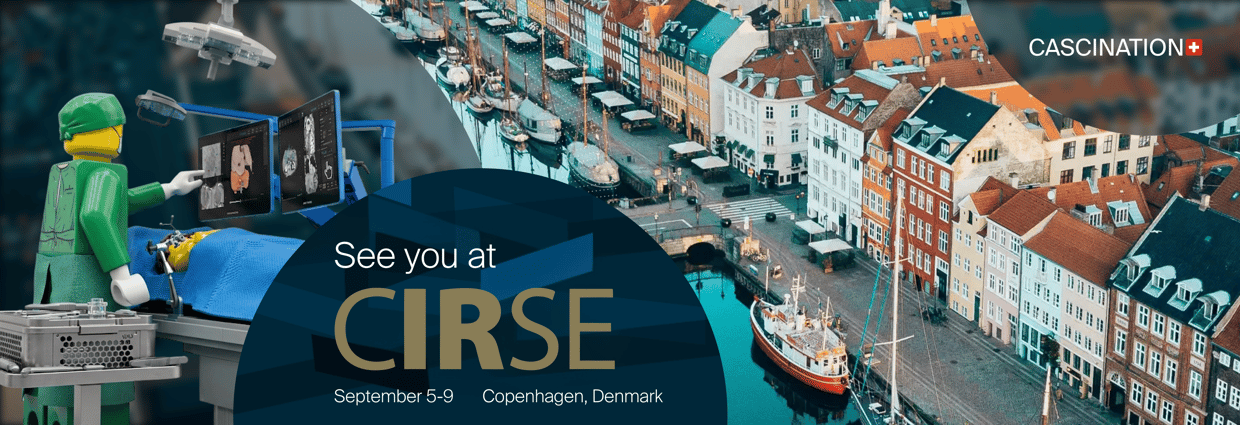
As we have grown over the years - so does our booth space. Once again, we will have two CAS-One IR systems present to give plenty of rich, hands-on experiences to interested physicians. We did this at CIRSE Barcelona last year, after the previous ECIO and CIRSE we had to force people to wait to try out CAS-One IR for themselves. This has been a welcome "problem" for us.
From a technology standpoint, this year we will be focusing on AblaFuse - our Automatic Fusion that launched early in the summer and has already supported hundreds of cases.
No longer will organ movement - for whatever reason - or tissue deformation disrupt a treatment plan, needle verification, or most importantly, an ablation confirmation. With little physician input, CAS-One IR will fuse images to ensure procedural accuracy is kept in all phases of the Quality Ablation workflow. Come by to see it for yourself - consider bringing a dataset to Copenhagen (pre and post contrast enhanced CT) and AblaFuse yourself.
See our full landing page dedicated to the release here
While at ECIO there are routinely 10+ abstracts focusing on CAS-One IR, generally at CIRSE there are fewer - we are eager to see what emerges - and will update this blog post prior to the event with the relevant posters if they are released ahead of time
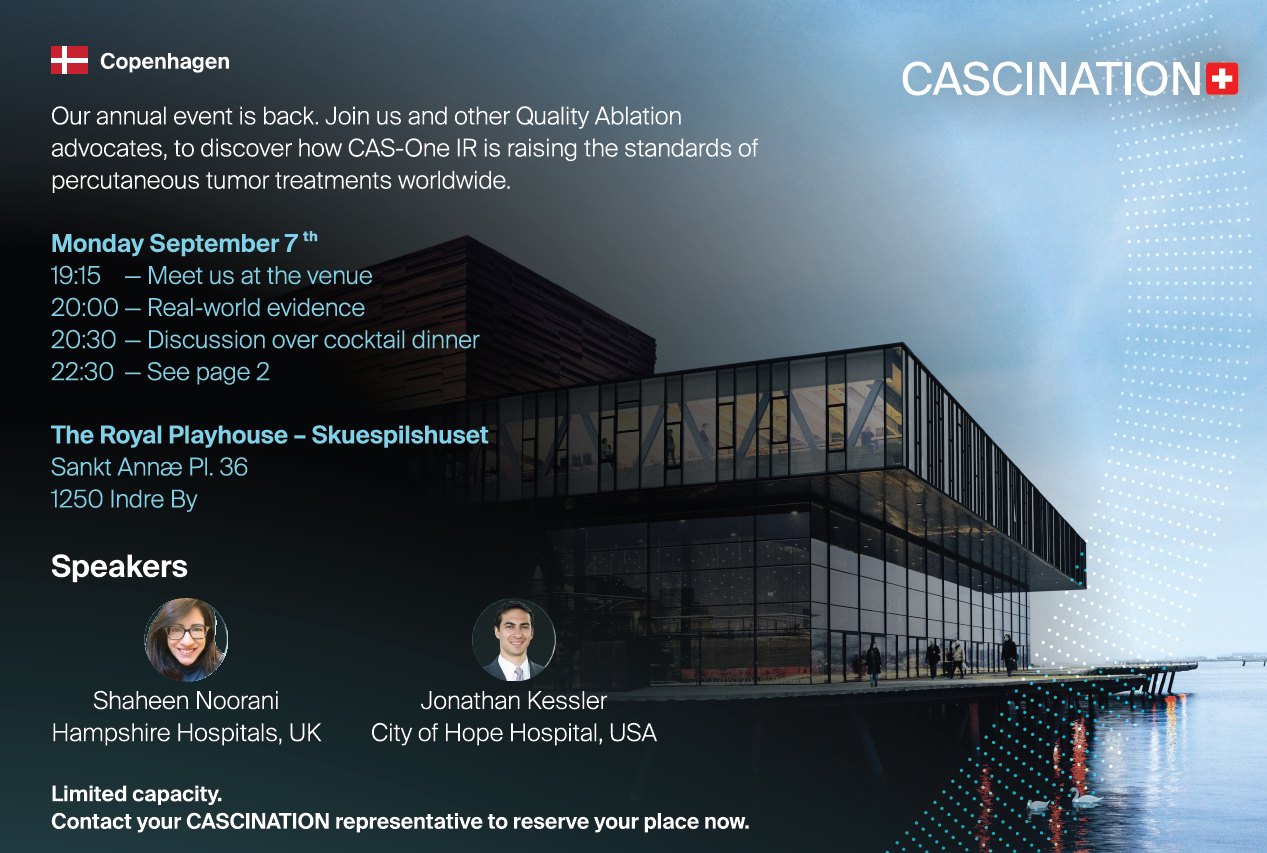
Of course, on the Monday evening, we are hosting our annual Scientific Dinner and afterparty - the scientific portion is led by CASCINATION's founder and CEO, Stefan Weber, and features presentations from Dr. Shaheen Noorani (UK) and Dr. Jonathan Kessler (USA). Dr. Noorani will feature her latest research, showing an astonishingly low LTP, and Dr. Kessler will present how CAS-One IR has drastically changed the tumor ablation program at his hospital (City of Hope). Please contact your local CASCINATION representative for an invitation as space is limited.
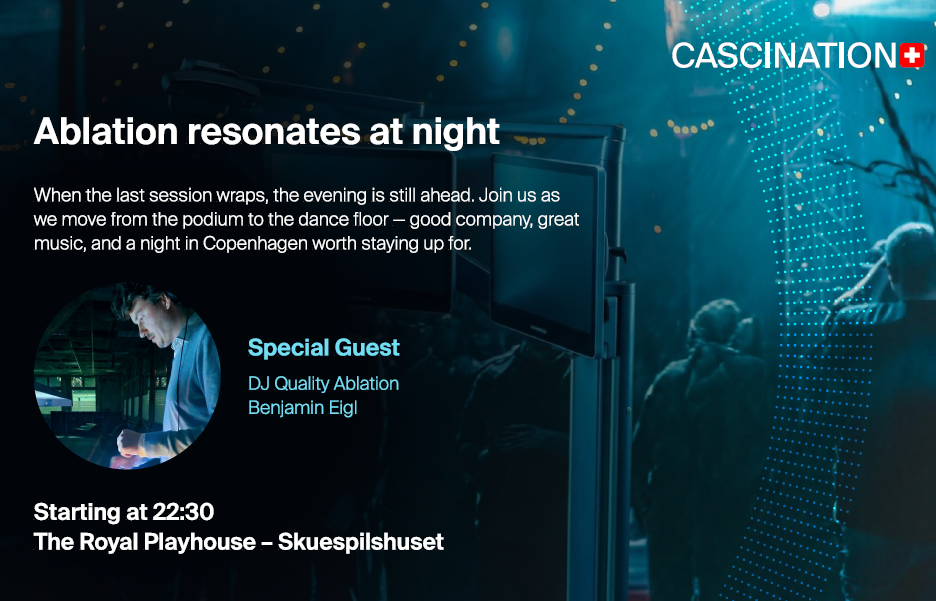
After the dinner discussions finish, we will again welcome DJ Quality Ablation and continue into the night!
Finally - every year we analyze the agenda and call out what we believe to be the most interesting topics - please see below for our guide to "can't miss" sessions focused on ablation.
Also, note side topics such as "Patient management: how to get referrals" as well as "Shifting from procedure focus to IR therapies and treatments", and a Film Interpretation Quiz, and more.
The full highlights are below - we will see you there.
Saturday September 5th
IR 126 – IR beyond interventions 10:00-11:00 Auditorium 11
126.1 Patient management: how to get referrals - M. Little
ERT 135 –Complications: dealing with the aftermath 11:30-12:30 Auditorium 12
135.1 Informed consent: why it’s important and how to do it effectively - E. Keller
135.2 Difficult conversations: how to speak with patients and relatives after a complication - N. McEniff
135.4 Learning from complications: how to conduct effective M&M meetings - F. Wolf
FC 162 - Renal Cancer 16:15-17:15 Auditorium 3
162.1 Building an RCC practice – P. Haslam
162.2 Must know literature in RCC ablation: an update - O. Graumann
162.3 Tumour tailored approach - T. Atwell
162.4 Tips and tricks for avoiding complications - C. Georgiades
BTL 164 – Percutaneous ablation 16:15-17:15 Room 20
164.1 Basic and emerging ablative therapies - H. Scheffer
164.2 Preventing complications in thermal ablation -M.Gkeli
SP 176 – Non-thermal ablation 17:30-18:30 Room 19
176.1 Irreversible electroporation for colorectal liver metastases: long-term outcomes from a transatlantic multicenter study - S. Van der Lei
176.2 Irreversible electroporation for hepatocellular carcinoma: explant-based ground truth of local efficacy and MRI response -C. Sorce
176.3 Ice nanonucleator-enhanced cryoablation improves perivascular ablation efficacy: phantom and porcine liver model study - D. Kim
176.4 Percutaneous electrochemotherapy for liver malignancies: early insights from the European prospective registry, RESPECT - A. Kovacs
Sunday September 6th
FS 215 Percutaneous ablation for benign indications – 8:30-9:30 Auditorium 10
215.3 Benign bone tumours: ablation as first-line treatment - M. Moussa
215.5 Ablation options in children - M. Temple
FS 216 – CIRSE vision: Shaping the future of interventional radiology – 8:30-9:30 Auditorium 11
216.1 The CIRSE Vision: three priorities, one goal - C. Binkert
216.3 Shifting from procedure focus to IR therapies and treatments - T. Kroencke
FS 212 – Lung ablation - 8:30-9:30 Auditorium 15
212.1 Must know literature in the NSCLC percutaneous ablation: an update - R. Goh
212.2 Literature update for percutaneous ablation in oligometastatic disease - E. Faiella
212.3 Imaging-guided precision - M. van Strijen
212.5 Lung ablation quality assurance - A. Tam
IRT 227 – Future treatments and innovations in IR 10:00-11:00 Auditorium 11
227.2 Future IO technologies - T. Auer
227.4 Future MSK IR technologies - V. Peric
CS 222 – Local cure for lung tumours 10:00-11:00 Auditorium 15
222.2 Early-stage NSCLC: percutaneous ablation - P. Cavalcante Viana
222.4 Oligometastatic disease: percutaneous ablation - J. Gaubert
222.6 SBRT failures: percutaneous ablation - J. Palussiere
FIQ 251 – Film Interpretation Quiz 14:30-15:15 - Auditorium 1
ERT 262 – Pancreatico-biliary cancer 16:15-17:15 Auditorium 11
262.1 Percutaneous ablation for intrahepatic cholangiocarcinoma - T. Inchingolo
SPH 269b – AI in IR: Who is responsible when the algorithm errs? 16:15-17:00 News on Stage
269b.1 Legal questions regarding AI in IR - T. Ali
269b.4 AI-driven real-time prediction of interventional radiology complications aligned with SIR and CIRSE patient safety sops: a four-year hospital-wide training study - M. Gupta
SP 267 – Thermal ablation 16:15-17:15 Room 19
267.1 Long-term survival outcomes of thermal ablation, transarterial radioembolization and resection for localized hepatocellular carcinoma in real world patients: a SEER database propensity score matched study - D. Chlorogiannis
267.3 Thermal ablation versus surgical resection for intermediate-size (3–5 cm) colorectal liver metastases: results from the Amsterdam colorectal liver met registry (AmCORE) - M. Dijkstra
267.4 Validation of a cross-modality automatic image registration system for intraoperative CRLM localization in CT-guided ablation: a dual-center retrospective study - X. Wu
Monday September 7th
FS 313 – Musculoskeletal interventional oncology – 8:30-9:30 Auditorium 2
313.1 Spine ablation which tumour which ablative therapy - R. Cazzato
313.3 Spine electrochemotherapy: tips and tricks for avoiding complications - F. Deschamps
313.4 Soft tissue sarcomas managing recurrences - S. Tutton
SPH 328 – How can AI make my life easier? - 10:00-11:05 News of Stage
328.1 AI in IR: what is the promise, and what actually works? - S. Solomon
328.7 Feasibility of generative AI for CT-guided liver biopsy trajectory planning: a pilot study - I. Echelman
SPH 369 – Training the next generation of interventional radiologists in the AI era - 16:15-17:15 News on Stage
369.1 Interventional radiology in 2036 F. Cornelis
369.2 How is AI going to affect training and education for next generation IRs? - L. Saccenti
369.3 LLM - friend or foe for developing clinical IR? K. Fung
MPJ 372 – Neuroendocrine tumours 17:30-18:30 Auditorium 15
372.1 Why NETs are unique: indolent but metastatic - A. Koumarianou
372.5 Decision-making: when to ablate, when to embolize, when to observe - L. Tselikas
CAS-One IR - Scientific Dinner - 19:15 - 22:00 - 1250 Indre By - Copenhagen
S. Weber, S. Noorani, J. Kessler
Tuesday September 8th
FS 424 – HCC: integrating IO therapies in the multidisciplinary pathway - 10:00-11:00 Auditorium 15
424.1 BCLC 2025 updates - M. Sanduzzi Zamparelli
424.2 / Ablation and TARE: patient selection in early-stage HCC - S. Young
SPH 428 – Robotics and human–machine interaction 10:00-11:00 News on Stage
428.1 What does robotics really add — and where does it stop? - U. Koç
428.3 How effectively does robotics mitigate operator radiation exposure? - M. Besler
428.4 Robotics in interventional oncology : the value of collaborative controls - Y. Le Meur
428.5 Development of a custom 7-dof robotic prostate fusion biopsy system utilizing 3-point volumetric co-registration: technical description and initial clinical validation - A. Aktas
MC 441 – Meet the CVIR authors 2 – Ablation 13:00-1400 News on Stage
441.1 / Intratumoural contrast tagging during CT-hepatic arteriography-guided microwave ablation of colorectal liver metastases (t-CTHA) to enhance tumour targeting and margin assessment - S. Van der Lei
441.2 / Impact of tumor size on outcomes of hepatic arteriography and C-arm CT-guided ablation (HepACAGA): > 3 cm is no absolute contraindication - N. Wijnen
441.3 / Microwave ablation of colorectal pulmonary metastases offers excellent local tumor control and can prolong time off chemotherapy - T. Cooke
441.5 / Risk factors for residual unablated tumour following CT-guided percutaneous renal cryoablation: lessons from the EuRECA registry - E. de Kerviler
CS 465 – Local cure for colorectal liver metastases - 16:15-17:15 Auditorium 15
465.1 Ablation for small CLM: time to replace surgery: con - A. Fretland
465.2 Ablation for small CLM: time to replace surgery: pro - M. Meijerink
Wednesday September 9th
ERT 512 – Ablation margins - 8:30-9:30 Auditorium 15
512.1 Clinical need and literature evidence - O. Moschovaki-Zeiger
512.2 Methodology, software and status - M. Calandri
512.3 Challenges for widespread adoption - B. Odisio
512.4 Ablation margin status as a valid imaging biomarker - E. Johnston
FS 522 – Advanced imaging navigation 10:00-11:00 Auditorium 11
522.5 Robotic navigation: what is currently missing? - B. Wood